Hasura In Production

Hasura can be a powerful accelerator for teams building data-driven applications, especially when speed of development and solid authorization are top priorities. After using it across multiple projects, here are my distilled notes on where Hasura shines—and where it introduces constraints you should be aware of.
Pros
- Instant GraphQL on top of PostgreSQL/MySQL Hasura auto-generates a fully typed GraphQL API from your existing tables and views—no need to manually write schemas or resolvers. This makes it extremely fast to go from schema design to a working API, especially for CRUD-heavy applications.
- First-class authorization and caching Authentication is delegated to your own auth provider, while Hasura transforms request headers into session variables. From there, its built-in RBAC model allows you to define fine-grained access rules at the row, column, and field level. Hasura also integrates caching layers that help reduce latency and offload repetitive queries.
- Easy to adopt The learning curve is minimal: the console is intuitive, the documentation is high quality, and the open-source community is active and responsive.
- Open-source with a strong ecosystem Hasura’s extensibility—metadata APIs, migrations, event triggers, and remote schemas—makes it suitable for a wide range of modern application architectures.
Cons
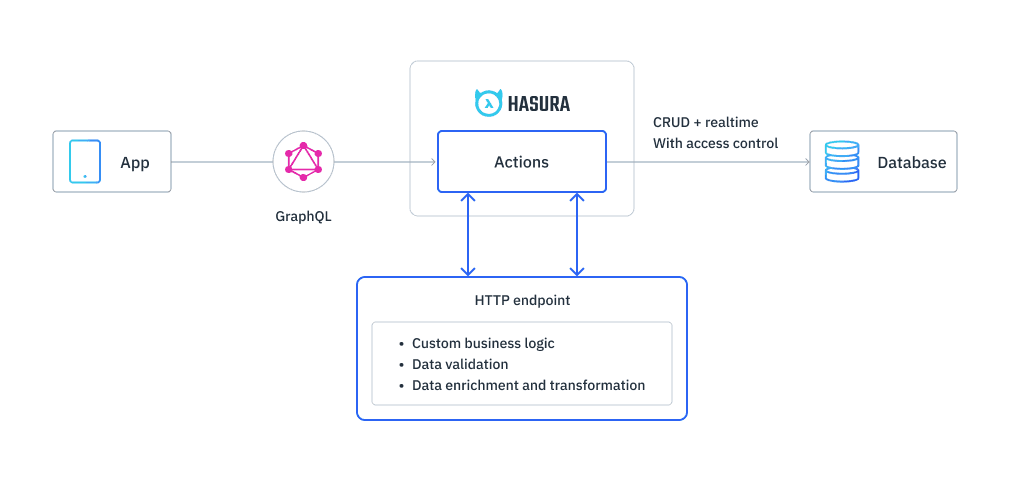
- Requires a custom backend for business logic For anything beyond pure data access—third-party service calls, domain-heavy logic, orchestration, or async tasks—you’ll still need to build an additional service layer using Actions, Remote Schemas, or custom microservices.
- Scaling considerations Hasura relies on SQL databases. While PostgreSQL scales well, extremely large-scale or highly distributed workloads may require architectures that go beyond what a single relational engine can support. NoSQL support is not available at the time of writing.
Summary
Hasura is an exceptional choice for small and medium-sized applications where rapid development, strong authorization, and predictable data modeling are priorities. However, if your system demands heavy business logic, complex orchestration, or large-scale sharding, you’ll likely need a more bespoke backend architecture—or use Hasura as just one part of a broader system.