Monolith vs. Microservices: Choosing the Right Architecture
Architecture debates often swing between two extremes — that monoliths are “old school” or that microservices are the “only modern way” to build software. In practice, neither view is accurate. Both architectures are valid tools with strengths, trade-offs, and ideal contexts. Understanding these trade-offs is far more important than joining either camp.
Through building and scaling complex web applications, onboarding systems, integrations, and event-driven infrastructure, I’ve had to choose — and sometimes migrate — between monolithic and microservice approaches. What follows is a distilled, experience-driven comparison aimed at helping teams choose intentionally rather than reactively.
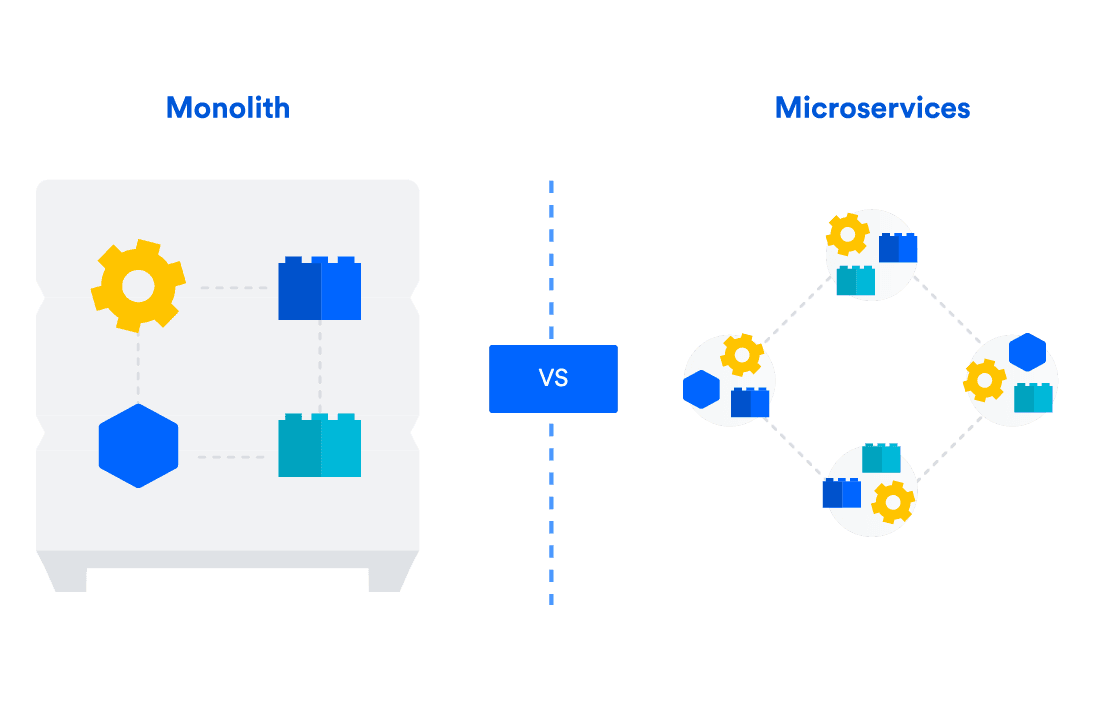
The Monolith: Fast, Focused, and Easier to Evolve Early On
A monolithic application consolidates all core functionality into a single deployable unit — API, backend logic, scheduled jobs, even templating or server-side rendering.
Where Monoliths Excel
- Speed of development: One repository, one deployment pipeline, and minimal overhead make early iteration extremely fast.
- Simpler refactoring: Changing a domain model or moving a piece of logic doesn’t involve cross-service contracts or version negotiations.
- Predictable local development: No swarm of Docker containers or distributed systems to run on every laptop.
- Lower operational burden: Minimal infrastructure, monitoring, and orchestration requirements.
Where Monoliths Struggle
- Scaling is coarse: If one module needs more compute, the whole application must scale with it.
- Large teams slow each other down: More developers touching the same codebase increases merge conflicts and deployment coordination.
- Risk of becoming a “ball of mud”: Poor boundaries can lead to tightly coupled code that becomes hard to change.
Monolithic architectures are often the best choice at the beginning — especially if a product is evolving quickly or the team is small. They only become a liability if boundaries are ignored for too long.
Microservices: Distributed Power With Real Operational Costs
Microservices decompose the system into small, independently deployable services that communicate through APIs or events.
Where Microservices Shine
- Independent deployments: Teams can ship features without waiting on a central release schedule.
- Fine-grained scaling: A compute-heavy service can scale separately from everything else.
- Clear domain ownership: Services map cleanly to specific business capabilities.
- Higher resilience: A failure in one service doesn’t automatically cascade across the system.
Where Microservices Hurt
- Complex operations: You now need distributed tracing, service discovery, versioning strategy, error retries, queue management, and observability tooling.
- Network overhead: What used to be a function call becomes a remote request prone to latency and failure.
- Higher infrastructure cost: Multiple CI/CD pipelines, databases or schemas, containers, and monitoring systems add up.
Microservices are powerful, but they demand engineering maturity — especially around DevOps and observability — that not all teams have in the early stages.
Key Lessons From Real-World Experience
Across different projects and domains, several patterns consistently emerge.
Start With a Monolith, Evolve Outward Only When Needed
Most successful systems begin as well-structured monoliths. You only extract services when you understand the problem space deeply enough to define stable boundaries. Moving too early adds unnecessary complexity without meaningful benefit. A common path is:
- Start monolithic for speed
- Introduce internal boundaries (modular monolith)
- Break out specific services only when the monolith shows real pain
- Keep shared logic and authentication centralized as long as feasible This avoids ending up with 20 microservices for a product that’s still figuring out its direction.
Split Services Based on Pain, Not Aesthetics
A service should be extracted only when its pain outweighs the cost of distribution.
Good indicators:
- A part of the system requires very different scaling characteristics
- A domain changes far more frequently than others
- A specific module introduces high deployment risk
- Specialized processing (e.g., heavy compute, batching, queue handling) slows down the rest of the app
Bad indicators:
- “Microservices are the cool modern thing”
- “This folder is too big”
- “We want to reorganize everything at once”
Architecture should solve problems, not create them.
Event-Driven Architecture Isn’t Magic — It Just Has Different Problems
Events (queues, topics, schedulers) help decouple services and support asynchronous workloads. But they introduce:
- eventual consistency
- duplicate events that must be handled idempotently
- schema versioning
- complex failure recovery
- distributed debugging challenges
Event-driven systems are powerful, but only when teams design for these realities intentionally.
Observability Becomes a First-Class Requirement
In distributed systems, logs alone are not enough. Once you move to microservices, you need:
- structured logs with correlation IDs
- metrics dashboards
- tracing across service boundaries
- consistent error handling policies
- visibility into queue backlogs and retries
Without this, microservices become effectively impossible to reason about.
Don’t Split the Database Prematurely
A shared database or schema can support far more scale than most teams expect.
Splitting databases too early introduces:
- cross-service consistency issues
- distributed transactions
- duplicated domain logic
It’s usually better to:
- keep one database initially
- enforce boundaries through schema design and service layers
- introduce replication and read models
- only separate databases when a clear technical or compliance need appears
So Which Architecture Should You Choose?
There is no universal answer — only trade-offs.
A monolith is usually the best starting point:
- when the product is evolving quickly
- when the team is small
- when you need rapid iteration
Microservices become valuable:
- when scaling bottlenecks appear
- when teams need autonomy
- when workloads differ significantly
- when deployment coordination slows delivery
The strongest architecture choices come from understanding how your system grows — not from following trends.